A gold-bearing VMS project with five target areas.
The Seneca VMS Gold Project is a past-producing volcanogenic massive sulphide (“VMS”) property 120 kilometres by road east of Vancouver, British Columbia.
Commodities: gold, silver, zinc, copper, lead. Option to acquire 100%, subject to CSE acceptance. Option announced Wednesday, October 29, 2026.
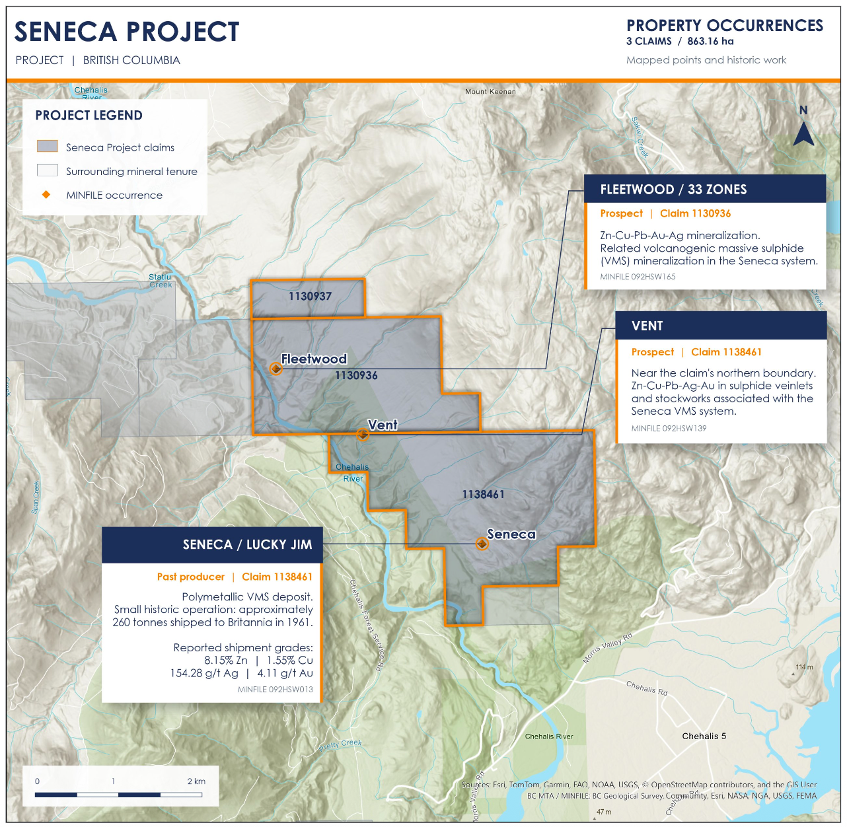
The Project comprises three contiguous mineral claims totalling 863.16 hectares on the east side of the Chehalis River, with road access by Highway 7 through Harrison Mills and the Chehalis Fleetwood Forest Service Road, and a power line on the property boundary.
Historical bulk shipment. Shearer (2023), citing the British Columbia Ministry of Mines and Petroleum Resources (1962), reports that 287 tons (about 260 tonnes) of crude ore from the Seneca open cut were shipped to Britannia Mines in 1961, with reported recoveries of 17 ounces of gold, 959 ounces of silver, 7,118 pounds of copper and 40,657 pounds of zinc (Shearer, 2023, p. 9; PDF p. 11).
Historical high-grade polymetallic intersections. Reported drilling at Seneca includes 2.6 metres grading 20.28% zinc, 0.94% copper, 100 g/t silver and 3.05 g/t gold, from 63.4 to 66.0 metres in hole SN05-57, as named in the historical reports; and 7.8 metres grading 9.1% zinc, 1.0% copper, 84.6 g/t silver and 2.8 g/t gold in hole 71-6. Both are reported core lengths (Shearer, 2023, pp. 24–25; PDF pp. 26–27).
Four historically identified zones along a 4.5-kilometre mineralized belt. Shearer (2023), summarizing Chapman (1999), places the Seneca, Vent, Fleetwood and 33 zones along a northwest-trending belt of felsic to intermediate volcanic rocks, with detailed drilling historically concentrated locally at Seneca and Vent.
SENECA VMS GOLD PROJECT
HISTORICAL DRILLING
Minnova, 1990 to 1993: 41 holes (12,109 m); found the Fleetwood and 33 zones.
Seneca deposit – SN05-57 (2005): 2.6 m from 63.4 m to 66.0 m grading 20.28% Zn, 0.94% Cu, 100 g/t Ag and 3.05 g/t Au
Seneca deposit – 71-6 (1971): 7.8 m grading 9.1% Zn, 1.0% Cu, 84.6 g/t Ag and 2.8 g/t Au
Vent – 85-12 (1985): 9.6 m from 43.4 m to 53.0 m grading 3.8% Zn, 0.2% Cu, 1.2% Pb, 28.8 g/t Ag and 0.73 g/t Au
33 – 92-33 (1992): 3.20 m grading 23.30% Zn, 1.83% Cu, 1.71% Pb, 133 g/t Ag and 2.33 g/t Au
Sources: Shearer (2023), printed pp. 10, 24-25 and 29, and Chapman (1999), printed pp. 5-7; underlying data not independently verified. Grade precision follows the 2023 report. NR means interval depths not stated in the reviewed summaries. A dash means the metal value was not reported, not zero. Assay data for hole 71-6 are not in the assessment reports. Pit Area holes were drilled near perpendicular to flat-lying beds; true widths at Vent cannot be determined.
Click to enlarge
SENECA VMS GOLD PROJECT
GEOLOGY
Mineralization is Kuroko-type VMS in Jurassic Weaver Lake Member volcanic rocks: stratabound massive sulphide lenses of pyrite, sphalerite, chalcopyrite and galena with barite, over stockwork feeder zones in altered dacite.
Sea-floor hot springs: Metal sulphides laid down on an ancient sea floor by volcanic hot springs.
Clusters along one horizon: The rest of the 4.5 km belt is the target.
Sulphide lenses over feeder zones: Pyrite, sphalerite, chalcopyrite and galena with barite.
Flat-lying host rocks: Pit Area holes cut the beds near perpendicular.
Four zones on one 4.5 km belt; two drilled in detail.
Seneca Pit Area (past producer): 2.6 m at 20.28% Zn (SN05-57). Stratabound massive sulphide lenses. Undrilled 800 × 800 m block to the northeast.
Vent Zone (1.5 to 2 km NW): 9.6 m at 3.8% Zn, 1.2% Pb (85-12). Stockwork veinlets in altered dacite.
Fleetwood and 33 Zones (about 3 km NW): 3.20 m at 23.30% Zn (92-33). Bedded massive sulphide at ~150 m over stockwork.
Trough Zone (1 km SE): Zn-Cu-Pb-Ag-Au silt anomaly over 600 m.
Historical core lengths from the 2023 technical report and Chapman (1999).
Click to enlarge
SENECA VMS GOLD PROJECT
previous work
More than 100 drill holes, 347 line-kilometres of airborne geophysics and more than 2,700 soil and rock samples are compiled in an independent NI 43-101 technical report dated October 1, 2023 (the “2023 Technical Report”) prepared on the predecessor claims covering the Seneca, Vent and Fleetwood zones, which recommends data compilation, geophysical reinterpretation, soil sampling and mapping to define drill targets.
1961
287 tons of crude ore from the Seneca open cut were shipped to Britannia Mines in 1961.
1971-1993
Cominco, Chevron, Curator, BP-Selco and Minnova drilled the property between 1971 and 1993.
2004-2006
Carat Exploration Inc. flew airborne geophysics and drilled 19 holes in 2004 to 2006.
SENECA VMS GOLD PROJECT
TARGETS & PHASE 1
Five target areas:
Northeast block (800 × 800 m): Block northeast of the Seneca deposit with no holes, bounded by mineralized intercepts.
EM anomaly (500 × 500 m): Between the Seneca and Vent zones, untested.
Trough Zone (1 km SE of pit): Zn-Cu-Pb-Ag-Au silt anomaly over 600 m, southeast of the pit.
UTEM corridor (4.2 km): Five weak UTEM conductors in a corridor from the pit.
Gold-in-silt (to 754 ppb): East of the Vent zone.
Phase 1 program: Data compilation, reinterpretation of historical geophysics, soil sampling and mapping, as recommended in the 2023 technical report ($120,000 estimate).
Next: Phase 2 program of geophysics and drilling, as recommended in the 2023 technical report.